Sinaloa
State in northwest Mexico, agricultural heartland and cartel stronghold.

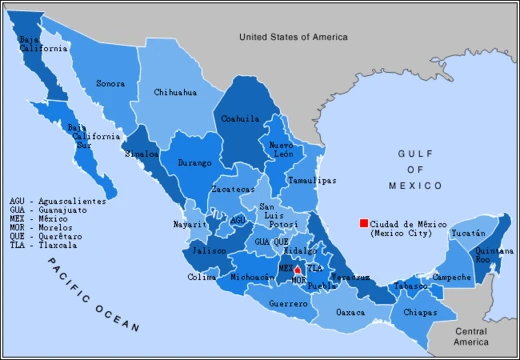
Sinaloa, officially the Free and Sovereign State of Sinaloa, is one of the 31 states that, along with Mexico City, compose the Federal Entities of Mexico. Located in northwest Mexico, it is bordered by Sonora, Chihuahua, Durango, Nayarit, and the Gulf of California. Its capital and largest city is Culiacán Rosales, and it is divided into 20 municipalities. Sinaloa is known for its agricultural output, musical traditions in banda and norteño genres, and as the home of the Sinaloa Cartel, a major criminal organization.
- Capital
- Culiacán Rosales
- Official Name
- Estado Libre y Soberano de Sinaloa (Free and Sovereign State of Sinaloa)
- Largest City
- Culiacán Rosales
Lore & Background
Sinaloa belongs to the northern limit of Mesoamerica, with the Fuerte River marking the boundary to Aridoamerica. Before European contact, the territory was inhabited by groups including the Cahitas, Tahues, Acaxees, Xiximes, Totorames, Achires, and Guasaves.
Reader's Guide
Sinaloa's significance stems from its dual identity as both a productive agricultural region—often called 'the granary of Mexico' due to large-scale irrigation projects and export-oriented crops—and as the birthplace of the Sinaloa Cartel, one of Mexico's largest criminal organizations. The state's economy is based on agriculture, fisheries, livestock, tourism, mining, and food processing. Culturally, it is renowned for banda and norteño music, its cuisine, and the heritage of indigenous peoples such as the Yaqui and Yoreme. In the postrevolutionary period, dams such as Sanalona, Miguel Hidalgo, and Humaya converted arid land into farmland. Beginning in the mid-20th century, poppy and cannabis cultivation in the Sierra Madre Occidental gave rise to a narcotics economy. Ongoing infighting in the Sinaloa Cartel continues to drive instability.
Did You Know?
- The name Sinaloa likely combines Cahita words 'sina' (pitahaya plant) and 'lobola' (rounded), shortened from 'sinalobola'.
- The state includes the islands of Palmito Verde, Palmito de la Virgen, Altamura, Santa María, Saliaca, Macapule, and San Ignacio.
Roots in the Sinaloa Countryside
The story of what would become the world's most formidable narcotics syndicate traces back to the late 1960s in the Mexican state of Sinaloa, where Pedro Avilés Pérez began smuggling cannabis across the border into the United States. Working alongside figures like Vicente Carrillo Leyva, Avilés is widely regarded as part of the first generation of major Mexican drug traffickers whose operations marked the true birth of large-scale Mexican narcotics smuggling. His most consequential innovation was the adoption of aircraft to move product, a method that would reshape how drugs crossed international borders for decades to come. Avilés's small operation served as an informal academy for a remarkable cohort of second-generation traffickers—including Rafael Caro Quintero, Ernesto Fonseca Carrillo, Miguel Ángel Félix Gallardo, Ismael Zambada García, and his own nephew Joaquín "El Chapo" Guzmán—all of whom later claimed they learned the fundamentals of the trade within his organization.
The Guadalajara Federation and Its Shattering
border throughout the 1980s. Gallardo structured his vast network as what he called a "Federation," a loose alliance of regional operators who each controlled specific territories and smuggling routes. This deliberate fragmentation was a survival strategy: by distributing leadership across multiple bosses and territories, the organization reduced the risk that a single arrest could dismantle the entire enterprise. One of these plazas was Sinaloa, headquartered in the city of Culiacán. By the late 1980s, the U.S. Drug Enforcement Administration already assessed the Sinaloa operation as the largest drug-trafficking organization functioning within Mexico.
Global Reach and the Chapo Era
Throughout the 1990s and 2000s, under the leadership of Joaquín "El Chapo" Guzmán, the Sinaloa Cartel transformed from a regional player into what the United States Intelligence Community now describes as the largest and most powerful drug-trafficking organization on Earth—potentially surpassing even Pablo Escobar's Medellín Cartel at its peak. The syndicate diversified its product portfolio dramatically, moving beyond its cannabis roots to become a dominant force in the global trade of cocaine, heroin, fentanyl, methamphetamine, and MDMA. Its logistics grew equally sophisticated: underground tunnels beneath the U.S.-Mexico border, maritime shipments, and the corruption of border officials all became standard tools for moving narcotics into American markets. The cartel's reach extended across the Americas, Europe, and Asia, with a particularly heavy footprint in the Mexican states of Sinaloa, Baja California, Durango, Sonora, and Chihuahua, as well as cities across the United States and as far as the Philippines. This expansion came at enormous cost. The Sinaloa Cartel waged prolonged violent wars against the Tijuana Cartel, the Gulf Cartel, and later the Jalisco New Generation Cartel, while simultaneously clashing with Mexican federal forces. Its ability to infiltrate local governments and law-enforcement agencies in key trafficking corridors further entrenched its dominance.
Leadership Turmoil and Enduring Resilience
The Sinaloa Cartel's leadership has been repeatedly tested by high-profile arrests, yet the organization has shown a remarkable capacity to absorb each blow. After Joaquín "El Chapo" Guzmán was captured in 2016, the old-school figure Ismael "El Mayo" Zambada stepped forward as a principal leader alongside Guzmán's sons—Jesús Alfredo Guzmán Salazar, Joaquín Guzmán López, and Iván Archivaldo Guzmán Salazar. authorities in El Paso, Texas, a stunning double removal from the top. Its operations continue to be fueled by persistent demand for narcotics in the United States and globally, and its influence has shaped the war on drugs, international and local politics, and popular culture far beyond the borders of Sinaloa. The pattern is clear: no single arrest, no matter how high-profile, has been sufficient to dismantle an organization whose infrastructure, alliances, and smuggling networks span multiple continents.
Frequently Asked Questions
What is Sinaloa and where is it located?
Sinaloa is one of Mexico's 31 states, officially named the Free and Sovereign State of Sinaloa, sitting in the northwest corner of the country along the Gulf of California. It is bordered by Sonora, Chihuahua, Durango, and Nayarit, and is split into 20 municipalities.
What is the capital and largest city of Sinaloa?
Culiacán Rosales serves as both the state capital and its most populous city. It anchors the political and commercial life of all 20 Sinaloan municipalities.
What is Sinaloa culturally known for?
The state is a major cradle of northern Mexican music, especially the banda and norteño traditions that shape the country's sound. It is also a significant agricultural producer and has gained grim international recognition as the birthplace of the Sinaloa Cartel.
More in Mexican States 1-19
Spotted an error? Know more?
This is a living reference — every entry is fact-audited, and reader corrections feed straight into our audit queue. Suggest an edit · See this site's audit record