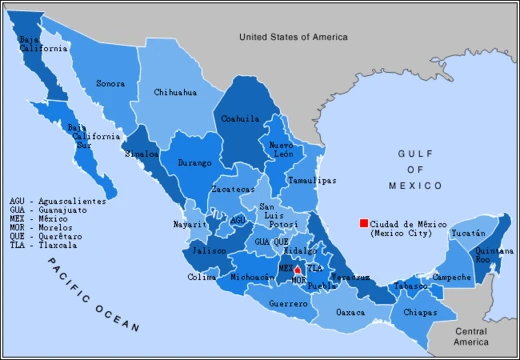
San Luis Potosí
Capital and most populous city of the Mexican state of San Luis Potosí.

San Luis Potosí, commonly referred to as San Luis, or by its initials SLP (Otomi: Nmiñ'u), is the capital and the most populous city of the Mexican state of San Luis Potosí. It is the municipal seat of the surrounding municipality of San Luis Potosí. The city lies at an elevation of 1,864 metres (6,115 feet). It has an estimated population of 824,229 in the city proper and a population of approximately 1,221,526 in its metropolitan area, formed with the neighbour city of Soledad de Graciano Sánchez and other surrounding municipalities, which makes the metropolitan area of Greater San Luis Potosí the eleventh largest in Mexico. The city is in the west-central part of the state of San Luis Potosí, at 22.16°N, 100.98°W. The municipality has an area of 1,443.14 square kilometres (557.20 square miles). It is part of the macroregion of Bajío.
- Capital
- San Luis Potosí
- Founded
- 1592
Verified Timeline
Lore & Background
In pre-Hispanic times, the territory now occupied by the state of San Luis Potosí included two cultural areas: Mesoamerica and Aridoamerica. The southern and eastern regions were occupied by Otomi and Huastec kingdoms, while the northern and central-west regions, where the city of San Luis now is located, were inhabited by Chichimeca. These nomadic peoples did not build large cities or have permanent settlements. After the arrival of Spanish conquistadores, it took about a century to colonize the northern territories. When settlers founded the first settlements in the late 16th century, they struggled against constant attacks from Guachichil tribes. Conquistadores and religious missionaries called the place where San Luis now is located 'El Gran Tunal' (Grand Place of Tuna fruit). In 1589, peace between Chichimeca peoples and Spanish settlers was reached thanks to efforts made by Miguel Caldera and Brother Diego de la Magdalena, which marked the end of the Chichimeca War. A Franciscan mission was established in the zone in 1583. In early 1592 the mines of Cerro de San Pedro were discovered. The lack of water in Cerro de San Pedro made impossible a new settlement in that specific area, so a valley where water was abundant originated the creation of a new township. The legal foundation of the town of San Luis Potosí was made in November 3, 1592 as part of the Viceroyalty of New Spain, according to a charter commission raised by Viceroy Luís de Velasco and given to Miguel Caldera (considered the historic founder of the city) and Juan de Oñate. The city is named after Louis IX of France (also known in Mexico as San Luis Rey de Francia, Saint Louis, King of France), who is the city's patron saint. Potosí was added in reference to the fabulously rich mines of Potosí, Bolivia, discovered some forty years before the city was founded, as the exploitation of silver and gold mines in Cerro de San Pedro was the main reason for the founding of the city. In 1786, San Luis Potosí became the capital of the Intendancy of San Luis Potosí, one of the twelve new administrative units of the Viceroyalty of New Spain created as part of the Bourbon reforms.
Reader's Guide
San Luis Potosí's significance stems from its historical role as a mining hub and its political importance during the 19th and early 20th centuries. For a time in 1863, during the French invasion of Mexico, San Luis Potosí served as the capital of the republican government, under President Benito Juárez. The Plan of San Luis Potosí, issued November 20, 1910, was the opening shot of Mexico's revolution against the dictator Porfirio Díaz. The 1910 presidential election was stolen when Díaz had his opponent Francisco I. Madero arrested and imprisoned. Madero fled and issued the Plan of San Luis Potosí, declaring the election void and calling upon Mexicans to take up arms against the government. Today, the downtown is one of plazas and colonial architecture. The 'Plaza de Armas' is the site of a cathedral and governor's palace (1770). The nearby 'Templo de Nuestra Señora del Carmen,' with its colorful tiled domes and famous altars, is considered among Mexico's finest churches; it was founded in 1749 by Fray Nicolás de Jesús María. In addition, San Luis is home to the bullring Plaza de Toros Fermin Rivera. The Universidad Autónoma de San Luis Potosí (UASLP) is in the city. Based on a Jesuit College founded in 1624, the Instituto Científico y Literario was raised to the category of a university in 1923, and is recognized as one of Latin America's best universities. Currently the city is one of the main industrial centers in central Mexico with a prolific manufacturing industry. A number of foreign industries have chosen to invest in San Luis Potosí in the last decades thanks to its strategic location for trade, as the city is located halfway between Mexico City and the United States border, as well as in the middle of the triangle formed by the three largest cities in Mexico: Mexico City, Guadalajara, and Monterrey. Besides its industrial economy, recently the city has been promoted as a touristic destination in central Mexico by state and federal programs. San Luis Potosí's historic center displays a remarkable mixture of different artistic styles in many buildings and is a major example of colonial architecture in Mexico. In 2010, the historic center was listed as a UNESCO World Heritage Site within Camino Real de Tierra Adentro.
Did You Know?
- The city's name 'Potosí' was added in reference to the fabulously rich mines of Potosí, Bolivia, discovered some forty years before the city was founded.
- In 1863, during the French invasion of Mexico, San Luis Potosí served as the capital of the republican government under President Benito Juárez.
- The Plan of San Luis Potosí, issued November 20, 1910, is considered the opening shot of the Mexican Revolution.
- The historic center was listed as a UNESCO World Heritage Site in 2010 within the Camino Real de Tierra Adentro.
- The Universidad Autónoma de San Luis Potosí is based on a Jesuit College founded in 1624 and was raised to university status in 1923.
Founding Forged by Silver and Struggle
San Luis Potosí was born from the promise of ore. When silver and gold veins were identified in the Cerro de San Pedro in early 1592, the immediate obstacle was water: the hillside proved too arid to sustain a settlement or support the heavy labor of extraction. Colonists therefore looked to a nearby valley where water was abundant, and it was there that a permanent township took shape. The legal charter was issued on November 3, 1592, under Viceroy Luís de Velasco, with the founding commission entrusted to Miguel Caldera (considered the historic founder of the city) and Juan de Oñate. The city's name weaves together two references: 'San Luis' for Louis IX of France, its patron saint, and 'Potosí' as an aspirational nod to the famous Bolivian silver mines discovered roughly forty years earlier. The surrounding land had long been home to Chichimeca nomadic groups who waged decades of resistance against Spanish expansion. A Franciscan mission had been established as early as 1583, and the 1589 peace negotiated by Miguel Caldera and Brother Diego de la Magdalena finally ended the Chichimeca War, clearing the ground for the town's formal founding. By 1786, the city had grown into the capital of a new intendancy within the Viceroyalty of New Spain, one of twelve new administrative units created as part of the Bourbon reforms.
A City That Shaped Mexican Politics
Few Mexican cities carry as much political weight in their name as San Luis Potosí. During the French invasion of 1863, when imperial forces threatened the republic, the city briefly became the seat of President Benito Juárez's government, serving as a refuge and administrative center for the republican cause. More than four decades later, the city's name would echo through a nation in upheaval. On November 20, 1910, Francisco I. Madero, having fled after Porfirio Díaz's agents arrested him following a stolen presidential election, issued the Plan of San Luis Potosí. The document declared the 1910 vote void and called on the Mexican people to rise in armed revolt against the dictatorship. That single act is widely regarded as the opening shot of the Mexican Revolution. The city's political significance stretches even further back: in 1786 it was elevated to capital of the Intendancy of San Luis Potosí, one of twelve new administrative districts created under the Bourbon reforms that reorganized the Viceroyalty of New Spain. From colonial governance to revolutionary proclamation, San Luis Potosí has repeatedly stood at the crossroads of Mexican statehood.
Colonial Splendor and Living Heritage
Walk through the historic center of San Luis Potosí and you pass through centuries of layered artistic ambition. The downtown is a collection of plazas and colonial-era buildings that blend multiple artistic styles into a single, cohesive streetscape, making it one of Mexico's finest surviving examples of colonial architecture. The Plaza de Armas anchors the core, flanked by the cathedral and the governor's palace, whose origins date to 1770. Just nearby, the Templo de Nuestra Señora del Carmen draws the eye with its vividly colored tiled domes and elaborately decorated altars; founded in 1749 by Fray Nicolás de Jesús María, it is routinely cited among the finest churches in Mexico. The Plaza de Toros Fermín Rivera, a bullring, adds another dimension to the city's cultural landscape. In 2010, the historic center earned UNESCO World Heritage status as part of the Camino Real de Tierra Adentro, a recognition that cemented its international prestige. State and federal tourism programs have since worked to promote the city as a destination, inviting visitors to experience a colonial core that sits in quiet contrast to the modern industrial city growing beyond its edges.
Industrial Heart of Central Mexico
Today, San Luis Potosí punches well above its weight as one of the principal industrial and manufacturing hubs in central Mexico. Its geographic position is a key advantage: the city sits roughly halfway between Mexico City and the United States border, and it occupies the center of the triangle formed by the country's three largest urban centers—Mexico City, Guadalajara, and Monterrey. This strategic placement, combined with its membership in the Bajío macroregion, has attracted waves of foreign investment in manufacturing over recent decades. The metropolitan area, which incorporates the neighboring city of Soledad de Graciano Sánchez and surrounding municipalities, now counts approximately 1,221,526 residents, making it the eleventh largest metro in the country. The city proper, perched at an elevation of 1,864 metres, houses about 824,229 people within a municipal territory of 1,443.14 square kilometres. Education anchors the city's intellectual life: the Universidad Autónoma de San Luis Potosí, descended from a Jesuit college established in 1624 and elevated to full university status in 1923, is recognized as one of Latin America's leading institutions of higher learning.
Frequently Asked Questions
Who is San Luis Potosí?
San Luis Potosí is one of Mexico's 32 federal states located in the eastern-central part of the country, taking its name directly from its capital city. It stretches across the Mexican Plateau and into eastern tropical valleys, and is organized into 59 municipalities.
What is San Luis Potosí's role in Mexican history?
The state briefly became Mexico's national capital in 1863 when President Benito Juárez moved the government there to escape the French Intervention. Its origins trace back to 1592, when gold and silver discoveries prompted the founding of the first settlement.
How did San Luis Potosí get its name?
The name fuses two references: King Louis IX of France and the legendary silver mines of Potosí in Bolivia. It captures both a colonial-era European nod and the region's wealth in precious metals.
Why is San Luis Potosí important to Mexico?
Beyond its mining legacy and short tenure as the capital, the state anchors major urban centers like Ciudad Valles, Matehuala, and Rioverde while preserving the cultural presence of indigenous groups such as the Otomi, Huasteco, and Pame. Its first constitution was ratified on October 16, 1826, cementing its place in the young republic.
What indigenous peoples are tied to San Luis Potosí?
The territory has long been home to the Otomi, Chichimeca, Huasteco, Pame, and Náhua communities. These groups shaped the land's cultural identity well before the 1592 mining settlement that grew into the modern capital.
More in Mexican States 1-19
Spotted an error? Know more?
This is a living reference — every entry is fact-audited, and reader corrections feed straight into our audit queue. Suggest an edit · See this site's audit record