Puebla
State in east-central Mexico, known for industry and cultural festivals.

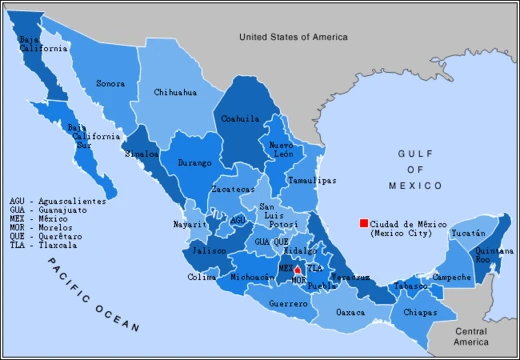
Puebla, officially the Free and Sovereign State of Puebla, is one of the 31 states that, along with Mexico City, comprise the Federal Entities of Mexico. By the end of the 18th century, the area had become a colonial province with its own governor, which became the State of Puebla after the Mexican War of Independence in the early 19th century. Today, the state is one of the most industrialized in the country, though development is concentrated in Puebla and other cities, leaving many rural areas undeveloped.
- Capital
- Puebla City
- Rank by size
- 20th of 31 states
- Average temperature
- 16 °C (61 °F)
Lore & Background
Puebla is located in the central highlands of Mexico between the Sierra Nevada and the Sierra Madre Oriental, with a triangular shape narrowing to the north. The state's hydrology is formed by three major river systems: one based on the Balsas River (also known as the Atoyac), one emptying into the Gulf of Mexico, and the closed Oriental Basin with many small lakes and springs. Puebla has eleven different climate zones, with five predominating, ranging from temperate and semi-moist in the center and south to warm and very wet in the north, and cold on high volcano peaks.
Reader's Guide
Puebla's significance lies in its role as a historically strategic trade route and its modern industrial development. Since the Mexican War of Independence, the area has continued to grow economically, mostly through industry, despite being the scene of a number of battles, the most notable being the Battle of Puebla. The state is home to five major indigenous groups: Nahuas, Totonacs, Mixtecs, Popolocas, and Otomi, mostly in the far north and far south. It is known for cultural contributions such as china poblana, mole poblano, active literary and arts scenes, and festivals including Cinco de Mayo, Ritual of Quetzalcoatl, Day of the Dead celebrations (especially in Huaquechula), and Carnival (especially in Huejotzingo).
Did You Know?
- Puebla is bordered by seven states: Veracruz, Oaxaca, Guerrero, Morelos, State of Mexico, Tlaxcala, and Hidalgo.
- Puebla has eleven different climate zones, with average temperatures ranging from cold on volcano peaks to warm in the north and southwest.
The Road to War – A Tripartite Crisis Turns French
The roots of the Battle of Puebla trace back to a financial dispute. What began as a multilateral debt-collection effort quickly fractured. Initial agreements at Orizaba in late January recognized Juárez's government and Mexican sovereignty, and all three powers agreed to hold negotiations inland. France made clear its intention to invade and interfere in Mexican governance, violating prior treaties. Britain and Spain settled their claims and withdrew, but Napoleon III's France chose a different path: leveraging the moment to build an empire anchored in Mexico. A well-armed French warship had already forced Juárez's administration into exile, and now a sizable French army was landing, setting the stage for a conflict that would culminate on the hills above Puebla.
Lorencez's Gambit – Storming the Forts
His objective was clear: seize the forts of Loreto and Guadalupe, perched on the hills overlooking the city, which would guarantee control of Puebla itself. He had been advised by Mexican collaborators Juan Almonte and Antonio de Haro y Tamariz to either attack the orchard of the Convento del Carmen opposite the fortified heights or simply bypass Puebla and march on the capital. He did neither. Instead, at half past eleven on May 5, Lorencez assembled an attack column of two battalions of zouaves, a battery under Captain Bernard, and four pieces of marine artillery from Captain Mallat's unit, with marine infantry and riflemen held in reserve. The assault on the two forts failed repeatedly. Unable to dislodge the Mexican defenders, Lorencez was forced to retreat to Orizaba to await reinforcements, and he was subsequently dismissed from command.
A Ragged Defense – Juárez's Faithful Soldiers
President Juárez, operating from a base in the north after being driven from the capital, assembled what could only be described as a ragged force of loyal soldiers and dispatched them south to Puebla. By May 4, General Miguel Negrete's division had taken up positions in the Guadalupe and Loreto Forts, while the remainder of the Republican Army quartered within the city itself. The contrast between the two forces was stark: the French brought well-equipped battalions of zouaves, marine artillery, and cavalry, while the Mexican defenders were a patchwork of faithful troops holding elevated ground. Mexican historian Francisco Bulnes later observed that Lorencez lacked the troops to starve the city, the artillery to intimidate it into surrender, and the resources for a gradual siege. His only viable option was a risky frontal storming of the forts—an assault that, as the battle would prove, could scarcely be expected to succeed against a determined and well-positioned defense.
From Battlefield to Cultural Memory
The Mexican victory at Puebla against a better-equipped French force became a powerful source of patriotic inspiration across the nation. In the state of Puebla itself, the anniversary is observed as El Día de la Batalla de Puebla, a day of local pride and remembrance. Recognition of the holiday extends to some degree in other parts of Mexico, though it remains most deeply rooted in the state where the fighting took place. Across the Atlantic, the date took on an entirely different cultural life. In the United States, May 5 evolved into Cinco de Mayo, a broad celebration of Mexican heritage that has grown far beyond the original military context. The French, meanwhile, did not abandon their campaign. Under the new command of Élie Frédéric Forey, French forces eventually captured Puebla, and the broader intervention continued. Yet the initial repulse on that May morning had already accomplished something no subsequent French victory could erase: it demonstrated that a smaller, less-equipped Mexican army could stand and win against a European power, and that memory continues to shape cultural identity to this day.
More in Mexican States 1-19
Spotted an error? Know more?
This is a living reference — every entry is fact-audited, and reader corrections feed straight into our audit queue. Suggest an edit · See this site's audit record