Morelos
Landlocked south-central Mexican state, named for the independence hero.

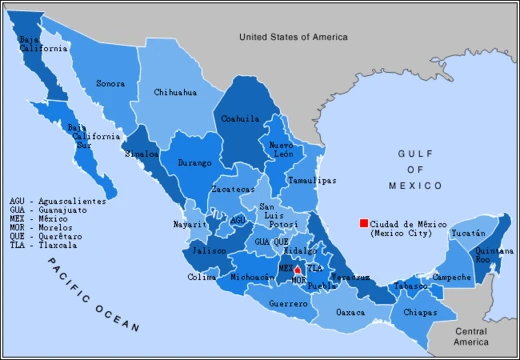
Morelos — officially the Free and Sovereign State of Morelos — is the second-smallest of Mexico's 32 Federal Entities, a landlocked state in south-central Mexico. Its 36 municipalities press up against the State of Mexico, Puebla, Guerrero, and Mexico City to the north. Cuernavaca is the capital.
- bordering_entities
- State of Mexico, Puebla, Guerrero, Mexico City
Lore & Background
The region now known as Morelos has a physical unity defined by its basin geography, into which abundant water flows. Later, during the Epiclassic period (c. A.D. A.D. The Tlahuica became the dominant ethnic group, organized into about fifty small city-states, with Cuauhnáhuac and Huaxtepec as the largest.
Reader's Guide
Morelos holds significance as a historically distinct region with a warm climate that supported sugar cane cultivation and attracted visitors since Aztec times. Its pre-Hispanic past includes Olmec, Toltec, Tlahuica, and Mexica influences, with advanced astronomy and agriculture. It is known for the Chinelos costumed dancers at Carnival and for the Monasteries on the slopes of Popocatépetl, a World Heritage Site. The region's history reflects a shift from subsistence maize and cotton to sugar refining, a system that lasted until the Mexican Revolution.
Did You Know?
- Morelos is the second-smallest state in Mexico, after Tlaxcala.
- The state was named after José María Morelos y Pavón, who defended Cuautla during the Mexican War of Independence.
- The Tlahuica were the dominant ethnic group in Morelos, organized into about fifty small city-states.
- The Monasteries on the slopes of Popocatépetl in Morelos are a designated World Heritage Site.
Geography & Political Identity
Morelos occupies a compact basin in south-central Mexico, a landlocked region defined by abundant water flowing into its interior. As the second-smallest of Mexico's thirty-two federal entities—trailing only Tlaxcala—it is divided into thirty-six municipalities with Cuernavaca serving as its capital. Its borders place it in close proximity to Mexico City to the north, the sprawling State of México to the northeast and northwest, Puebla to the east, and Guerrero to the southwest. The warm, year-round climate and the basin's natural water supply have made the region attractive to settlers and visitors from the Valley of Mexico since at least the Aztec era, giving Morelos a long history as a destination rather than merely a transit point.
Indigenous Peoples & Pre-Hispanic History
The earliest identified cultural imprint belongs to the Olmec, whose dominance lasted from about 200 B.C. to A.D. Successive Toltec migrations reshaped the landscape: one group established Mazatepec in A.D. The Tlahuicas organized themselves into roughly fifty small city-states, each governed by a hereditary tlatoani, and developed sophisticated astronomy and irrigation-based cotton cultivation. The Mexica conquered the region between the 1420s and mid-fifteenth century, sealing their control through the marriage of emperor Huitzilihuitl to Miahuaxochitl, whose son would become Moctezuma Ilhuicamina. By the sixteenth century, the two tributary provinces centered on Cuauhnáhuac and Huaxtepec each held populations exceeding fifty thousand.
Agricultural Transformation & Economic Life
The arrival of the Spanish fundamentally reoriented Morelos's agricultural economy. Where earlier inhabitants had focused on subsistence maize and cotton cultivation, the colonial period introduced sugar cane on a commercial scale, with nearby mills refining the crop into sugar. This plantation-and-mill system persisted with relatively little change until the upheaval of the Mexican Revolution. The state's warm, year-round climate proved ideal for sugar cane and a variety of other crops, anchoring the local economy for centuries. Even before the Spanish, cotton had been a pillar of Tlahuica life: it was planted wherever irrigation allowed, and Tlahuica women spun and wove the fiber into cloth that served both as a trade commodity and as the primary form of tribute owed to the Aztec overlords. The Mexica extracted tribute largely in cotton goods from the two tributary provinces they controlled. Tradition also credits Moctezuma Ilhuicamina with establishing a botanical garden in Huaxtepec (Oaxtepec), and his favorite swimming spot is thought to have been a pond called Poza Azul, which today lies within the grounds of a Six Flags Hurricane Harbor resort.
Cultural Heritage & Living Traditions
On the slopes of Popocatépetl, a cluster of monasteries holds UNESCO World Heritage Site status — colonial-era religious architecture that still turns heads. In the communities below, the Chinelos hit the streets in their full, elaborately costumed regalia for Carnival and festivals spread across the state. Push further back and the landscape gets more layered: Olmec reliefs at Chalcatzingo, the architectural legacy still visible at Xochicalco, the Tlahuica city-state network that once ran through the region. People from the Valley of Mexico have been making this trip since Aztec times, and the blend of pre-Hispanic heritage with living tradition is what keeps pulling folks in year after year.
Frequently Asked Questions
Who is Morelos named after?
The state honors José María Morelos y Pavón, a key military leader of the Mexican War of Independence who famously held the line at Cuautla against Spanish royalist forces.
Where is Morelos located and what borders it?
It sits landlocked in south-central Mexico, sharing borders with the State of Mexico, Puebla, Guerrero, and Mexico City on its northern edge.
What is the capital of Morelos?
Cuernavaca serves as the state capital and anchors the 36 municipalities that make up the territory.
How big is Morelos compared to other Mexican states?
It ranks as the second-smallest of Mexico's 32 federal entities, making it a compact but historically significant region in the country's south-central area.
More in Mexican States 1-19
Spotted an error? Know more?
This is a living reference — every entry is fact-audited, and reader corrections feed straight into our audit queue. Suggest an edit · See this site's audit record