Nuevo León
Northeastern Mexican state with a major industrial economy.

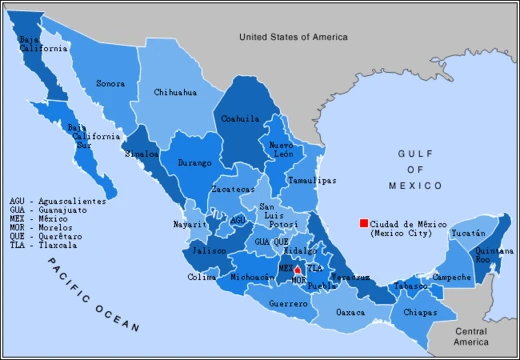
Nuevo León is a state in northeastern Mexico, bordered by Tamaulipas, Coahuila, Zacatecas, and San Luis Potosi, with an extremely narrow international border with the U.S. state of Texas. Covering 64,156 square kilometers and with a population of 5.78 million as of 2020, it is the thirteenth-largest federal entity by area and the seventh-most populous. Its capital, Monterrey, is the ninth-largest city in Mexico and part of the second-largest metropolitan area in the country, which houses about 92% of the state's population. The state is a major manufacturing hub with one of Mexico's largest economies, and its history includes pre-Hispanic nomadic groups, Spanish colonization as the New Kingdom of León, and industrialization beginning in the late 19th and early 20th centuries.
- Area
- 64,156 square kilometers (24,771 square miles)
- Population (2020)
- 5.78 million
- Capital
- Monterrey
- Largest Metropolitan Area
- Monterrey metropolitan area (5.3 million in 2020)
- Statehood
- 1824
- Major Industry
- Manufacturing
Lore & Background
Prior to European colonization, Nuevo León was home to about 250 distinct indigenous nomadic groups, collectively called chichimecas by the Spaniards. These groups, including the Coahuiltecans to the west, Alazapas to the north, the 'Borrados' to the east, and the Guachichiles to the south, lived in small bands, relying on hunting and gathering, and built temporary settlements called rancherías. They did not develop political hierarchies or permanent land claims. Spanish colonization began with Luis Carvajal y de la Cueva's expedition in 1580, establishing the New Kingdom of León in 1582, but permanent settlement did not occur until 1596, when Diego de Montemayor founded the Ciudad Metropolitana de Nuestra Señora de Monterrey on 20 September. During the colonial period, evangelization by Franciscan friars led to the establishment of twenty missions, ten of which are present-day municipalities. The territory lost claims to Coahuila in 1643 and to present-day Tamaulipas with the establishment of Nuevo Santander. During the Mexican War of Independence, the region initially remained royalist, with a high proportion of white or criollo ancestry (63% in 1790). After independence, on 7 May 1824, Nuevo León became a state. Industrialization began in the late 19th and early 20th centuries, accelerating after the Mexican Revolution, leading to its current status as a major manufacturing hub.
Reader's Guide
Nuevo León's significance lies in its transformation from a sparsely populated colonial frontier into one of Mexico's most economically powerful states. Its capital, Monterrey, anchors the second-largest metropolitan area in the country, housing about 92% of the state's population. The state's industrial base, developed from the late 19th century onward, makes it a key manufacturing center and contributes to one of Mexico's largest economies. Historically, the region's name derives from the New Kingdom of León, established by Luis Carvajal y de la Cueva in 1582, reflecting its Spanish colonial roots. The state's pre-Hispanic heritage includes numerous nomadic groups that left archaeological remains such as cave paintings. Nuevo León's legacy includes its role in the Mexican War of Independence, where it initially resisted the insurgency due to strong royalist ties, and its later industrial growth that shaped modern Mexico.
Did You Know?
- About 92% of Nuevo León's population lives in the Monterrey metropolitan area, which had an estimated 5.3 million people in 2020.
- Prior to European colonization, historians estimate there were about 250 distinct indigenous nomadic groups in the state's territory.
- Monterrey was founded three times: first by Alberto del Canto in 1577, then by Luis Carvajal y de la Cueva in 1582, and finally by Diego de Montemayor on 20 September 1596.
- The state's name comes from the New Kingdom of León, named by Luis Carvajal y de la Cueva after the Kingdom of León due to similarities in mountainous terrain.
- Nuevo León became a state of Mexico on 7 May 1824.
Geography & Demographic Concentration
Nuevo León sits in northeastern Mexico, sharing borders with four neighboring states—Tamaulipas, Coahuila, Zacatecas, and San Luis Potosi—while maintaining an extremely narrow international border with the U.S. state of Texas. The territory spans 64,156 square kilometers (24,771 square miles), placing it thirteenth among Mexico's federal entities by area. As of 2020, roughly 5.78 million residents call the state home, making it the seventh-most populous. What makes the demographic picture striking is its extreme concentration: the Monterrey metropolitan area, the nation's second-largest urban cluster with an estimated population of 5.3 million in 2020, absorbs approximately 92% of the state's total population. Monterrey itself ranks as the ninth-largest city in Mexico. This means that outside the metro corridor, the vast majority of the state's 24,771 square miles remain sparsely inhabited, creating a sharp contrast between the densely packed urban core and the wide-open hinterland.
Prehispanic Nomadic Life
Long before Spanish boots touched the soil, roughly 250 distinct nomadic bands roamed what is now Nuevo León. The arriving colonizers collectively labeled them chichimecas, but archaeological evidence—cave paintings and carved stones—allows historians to distinguish at least four principal peoples: the Coahuiltecans in the west, the Alazapas to the north, the so-called 'Borrados' in the east, and the Guachichiles in the south. These groups followed the rhythms of Aridoamerica, moving in small family bands in search of food. Their temporary camps, called rancherías, sheltered just one or two families in semispherical huts woven from branches and topped with thatch. Communities near the Salinas river or nestled in the cooler climes of the Sierra Madre Oriental could supplement their diet with fishing and limited agriculture. Crucially, because they never anchored themselves to fixed territory, these peoples never developed the layered political hierarchies characteristic of Mesoamerican civilizations. Governance, as the Spaniards understood it, simply did not exist in their decentralized social fabric.
Three Foundings and the Colonial Struggle
The Spanish conquest of this territory was anything but a single, decisive event. Alvaro Núñez Cabeza de Vaca led one of the first expeditions into Nuevo León territory in 1535. The first serious colonization push came in 1577 when Alberto del Canto established Santa Lucía on the site of present-day Monterrey. Indigenous resistance—branded by the colonizers as Indios Bárbaros—quickly dismantled that effort. Luis Carvajal y de la Cueva, a member of del Canto's expedition, traveled to Spain in 1579 and secured royal backing from King Philip II. He returned in 1580 and formally proclaimed the New Kingdom of León in 1582, founding San Luis Rey de Francia atop the old Santa Lucía site, thus marking Monterrey's second founding. Yet Carvajal's tenure collapsed in 1588 when the Inquisition accused him of being a descendant of New Christians, and the region lapsed back into near-abandonment. It was not until 1596 that Diego de Montemayor, leading twelve families, laid the third and permanent foundation of Monterrey on 20 September. Evangelization followed: the Franciscan convent of San Andrés opened in 1602, and twenty missions were eventually established, ten of which survive as present-day municipalities.
From Frontier Outpost to Industrial Powerhouse
The transformation of Nuevo León from a remote colonial outpost into an economic engine of Mexico unfolded over roughly a century. The state's industrialization took root in the late nineteenth and early twentieth centuries, when a wave of large enterprises took shape in and around Monterrey. The upheaval of the Mexican Revolution, rather than stalling this momentum, actually accelerated it, pushing the region deeper into manufacturing and heavy industry. Today, Nuevo León stands as a major manufacturing hub and houses one of Mexico's largest economies. The state's official title—Free and Sovereign State of Nuevo León—reflects its 1824 admission as a full state following the successful war for independence, a status that has underpinned its political and economic autonomy ever since. The name itself carries a sixteenth-century echo: Carvajal had dubbed the region the New Kingdom of León after noticing the mountainous terrain's resemblance to the old Iberian kingdom, and that shorter form, Nuevo León, has endured to this day.
Frequently Asked Questions
Who is Nuevo León?
Nuevo León is a northeastern Mexican state whose capital, Monterrey, ranks as the ninth-largest city in the country. It occupies a borderland position between Tamaulipas, Coahuila, San Luis Potosí, and the U.S. state of Texas, giving it a distinctive cross-border identity.
What are Nuevo León's powers/role?
The state operates as one of Mexico's most powerful manufacturing engines, anchoring the third-largest metropolitan area in the nation with roughly 5.3 million residents. Its industrial output has kept it among the country's top economies ever since factory-based growth took off in the late 1800s.
How does Nuevo León's story end?
Because it is a living jurisdiction rather than a concluded narrative, Nuevo León's arc is still unfolding; it has held statehood continuously since 1824. Its current chapter centers on sustaining industrial dominance while managing a population of nearly 5.8 million spread across 64,156 square kilometers.
Why is Nuevo León important?
It punches far above its weight in Mexico's economic landscape, producing a disproportionate share of the nation's manufactured goods from its northeastern corner. The Monterrey metro area alone rivals many entire countries in industrial capacity, making the state a critical pillar of Mexican industry.
What's Nuevo León's origin story?
Before Spanish settlers established the New Kingdom of León, the region was traversed by pre-Hispanic nomadic groups who adapted to its semi-arid terrain. The state's name directly echoes the Castilian province of León, linking its identity to that colonial-era founding.
More in Mexican States 1-19
Spotted an error? Know more?
This is a living reference — every entry is fact-audited, and reader corrections feed straight into our audit queue. Suggest an edit · See this site's audit record