Campeche
A Mexican state with a colonial capital and offshore oil wealth.

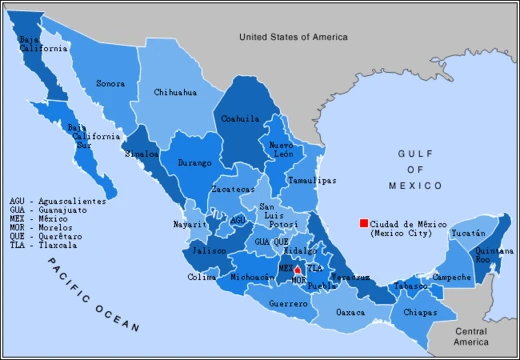
Campeche, officially the Free and Sovereign State of Campeche, is one of the 31 states which, with Mexico City, make up the 32 federal entities of Mexico. Located in southeast Mexico, it is bordered by the states of Tabasco to the southwest, Yucatán to the northeast, Quintana Roo to the east, by the Petén department of Guatemala to the south, and by the Orange Walk District of Belize to the southeast. It has a coastline to the west with the Gulf of Mexico. The city was a rich and important port during the colonial period, but declined after Mexico's independence. Campeche was part of the province of Yucatán, but split off in the mid-19th century, mostly due to political friction with the city of Mérida. Much of the state's recent economic revival is due to the discovery of petroleum offshore in the 1970s, which has made the coastal cities of Campeche and Ciudad del Carmen important economic centers. The state has important Mayan and colonial sites; however, these are not as well-known or visited as much as others in the Yucatán.
- Capital
- Campeche
- Statehood
- Mid-19th century (split from Yucatán)
- Country
- Mexico
- Known for
- Petroleum discovery in the 1970s, Mayan and colonial sites, World Heritage capital
Lore & Background
The name Campeche is derived from Can Pech, the Maya name of a chiefdom of the southwestern Yucatán Peninsula that existed at the time of the arrival of the Spanish conquistadors in the sixteenth century. The capital city of the chiefdom of Can Pech was called 'Ah-Kin-Pech', where the city of Campeche is now. Lazarus' Sunday'. The native name means 'place of snakes and ticks'. Most of the surface is of sedimentary rock, much of it of marine origin. The area with the highest elevations is near the borders with Guatemala and Quintana Roo. Notable elevations include Cerro Champerico, Cerro los Chinos, Cerro El Ramonal, Cerro El Doce, and Cerro El Gavilán. However, these hills are separated by large expanses of lower flat land. In the south of the municipality of Champotón begin a series of rolling hills known as the Sierra Alta or Puuc, which extend northeast to Bolonchen and then into the state of Yucatán. Other areas of these rolling hills lie near the city of Campeche, the main ones known as Maxtum, Boxol and El Morro. Another set is called the Sierra Seybaplaya in the center of the state. Rainforest areas subdivide into a number of types which include perennial tall tree rainforest, semi perennial tall tree rainforest, deciduous medium height tree rainforest, semi-deciduous medium height tree rainforest, deciduous low height tree rainforest and semi-perennial low height tree rainforest. Away from the coast, these rainforests are interspersed with savannah areas and along the coast are accompanied by areas with sand dunes, mangrove wetlands and estuaries. Species that can be found in the various rainforests include Spanish cedar, oxhorn bucida, Campeche logwood, and wild tamarind. It also includes a number of precious tropical hardwoods such as red cedar, Honduran mahogany, ziricote and Hollywood. Along the coastal areas, palms dominate such as the coconut tree and royal palm. The main wildlife species in the state are the jaguar, ocelot, puma, deer, collared peccary, raccoon, hare, ring-tailed cat and Yucatan spider monkey. There are many bird species including the plain chachalaca, quail, pelican, and toucan. Reptiles include rattlesnakes, coral snakes, boa constrictors, various species of sea and land turtles, iguanas, and crocodiles.
Reader's Guide
Campeche's significance lies in its dual heritage as a colonial port and a modern petroleum hub. After Mexico's independence, the city declined, but the discovery of offshore petroleum in the 1970s spurred an economic revival, making coastal cities like Campeche and Ciudad del Carmen important economic centers. The state also contains important Mayan and colonial sites, though these are less visited than those elsewhere in the Yucatán Peninsula. Politically, Campeche's executive power rests in the governor, and legislative power in the Congress of Campeche, a unicameral legislature of 35 deputies. The state's geography is predominantly flat with sedimentary rock, featuring rainforests, savannahs, and coastal mangroves. Its ecosystems support diverse wildlife, including jaguars, ocelots, and toucans, though habitat destruction and hunting have reduced populations. The Laguna de Términos lagoon system in the southwest is the most important lake-lagoon system in the country, supporting aquatic species like sea bass, crabs, and oysters. Campeche's climate is tropical with a rainy season and occasional hurricanes in late summer.
Did You Know?
- The name Campeche comes from the Maya 'Can Pech', meaning 'place of snakes and ticks'.
- Campeche split from the province of Yucatán in the mid-19th century due to political friction with Mérida.
- Offshore petroleum discovered in the 1970s revived the state's economy.
Frequently Asked Questions
What is Campeche most known for?
The state is widely recognized for the offshore petroleum reserves tapped in the 1970s, as well as its Mayan archaeological sites and the well-preserved colonial architecture in its capital.
Where is Campeche located and what borders it?
Campeche sits in southeast Mexico, bordered by Tabasco, Yucatán, and Quintana Roo, with Guatemala's Petén department and Belize's Orange Walk District to the south and southeast. The Gulf of Mexico lies to its west.
More in Mexican States 1-19
Spotted an error? Know more?
This is a living reference — every entry is fact-audited, and reader corrections feed straight into our audit queue. Suggest an edit · See this site's audit record